

With its bright white skin standing out against the dark waters of the river, the beluga whale never goes unnoticed. A true star of the St. Lawrence, it captures attention with its unique appearance and surprisingly expressive face.
Think you know this white whale well? Behind its friendly look lies a fascinating species with a remarkable history and some truly surprising behaviors.
Come aboard as we take you on a journey to discover 10 fascinating facts about the beluga, one of the most iconic marine mammals of the St. Lawrence.
1. It is the only cetacean that lives in the St. Lawrence year-round
Unlike many other cetacean species that travel thousands of kilometers every year (the humpback whale, a true globe-trotter of the oceans, comes to mind!), the St. Lawrence beluga population resides here permanently. These white whales have made the river their year-round home.
An interesting fact: this is the southernmost beluga population in the world! This is particularly surprising given that the species is generally associated with Arctic waters. The St. Lawrence provides a rich, diverse, and productive habitat where belugas can live, feed, and raise their young.
During the summer, these belugas occupy a vast area of approximately 200 kilometers throughout the estuary. Their range extends from L'Isle-aux-Coudres to Bic Island, west of Rimouski, passing through Forestville on the North Shore.
They also regularly frequent the Saguenay Fjord, from its mouth to Saint-Fulgence. This area is especially rich in nutrients, fish, and resting zones, making it a vital hub for the population. In short, the beluga is not merely a visitor. Its year-round presence makes it a true ambassador of the St. Lawrence. Protecting the species is all the more important because the health of the river's entire ecosystem directly affects its survival.
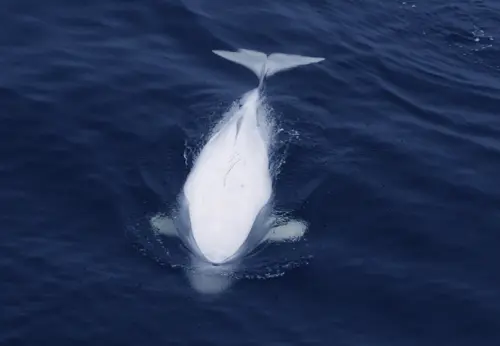
2. It is nicknamed the "Canary of the Sea"
If the beluga is known as the "canary of the sea," there is a good reason for it. The species is famous for the wide variety of sounds it produces: clicks, chirps, squeaks, whistles, and more. It has an impressive vocal repertoire that can sometimes be heard both underwater and at the surface under ideal conditions. These sounds form a complex language that researchers are still working to better understand.
Beyond communication, these vocalizations play an essential role in echolocation, a natural sonar system that allows belugas to "see" through sound. This ability is shared with other marine mammals such as dolphins, as well as bats on land. It is crucial for navigating environments where light penetration is limited.
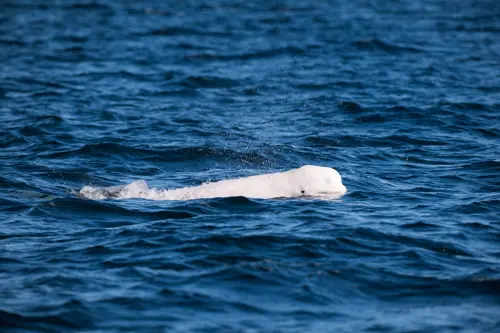
3. It can swim backward
Unlike most cetaceans, whose bodies are designed to move forward, the beluga is capable of an unusual feat: swimming backward.
This rare ability among whales and dolphins is made possible by its unique anatomy, particularly its flexible neck and highly maneuverable pectoral flippers. This flexibility allows the beluga to reposition itself quickly, avoid obstacles, and even move away from predators more efficiently.
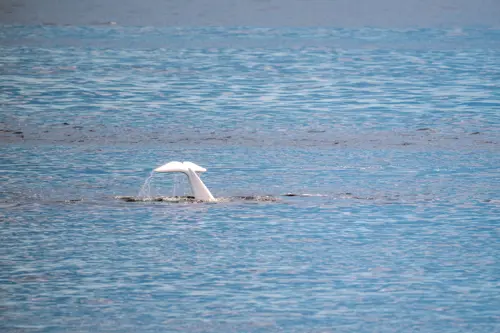
4. Its name means "white" in Russian
The word beluga comes from a Russian term meaning "white." A fitting name when thinking of the pristine beauty of an adult beluga, but somewhat misleading when looking at calves.
Belugas are not born white. At birth, their skin is typically brownish, resembling the color of a latte. As they grow, they go through a wide range of colors: brown during their first year, bluish around age two, gray throughout their juvenile years, and finally the pure white that defines adulthood at around 12 years old.
This white coloration is more than just beautiful. It serves as natural camouflage. In environments dominated by snow, ice, and Arctic light, white coloration helps belugas blend into their surroundings, making them harder for predators to spot.
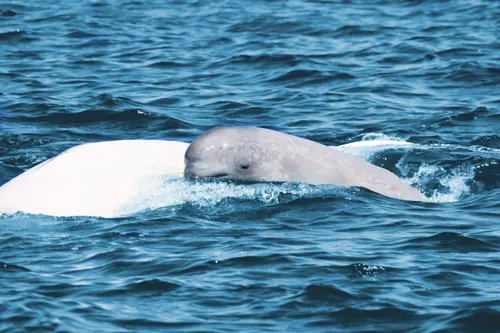
5. It can turn its head in every direction
The beluga's neck is one of its most remarkable features. Unlike almost all other cetaceans, whose neck vertebrae are fused to support powerful forward swimming, belugas have seven unfused cervical vertebrae.
The result? They can turn their heads from side to side and up and down, almost like humans. This mobility is extremely rare among whales. Only one other species shares this characteristic: the narwhal, often called the "unicorn of the sea."
This flexibility is highly useful. In areas where ice forms natural labyrinths, the ability to move its head freely helps the beluga locate prey, assess obstacles, and navigate with precision in an often unpredictable environment.
6. The beluga's forehead bump Is called a "melon"
The rounded shape of this prominent forehead structure is exactly why it is called a melon. All toothed whales, including dolphins, sperm whales, and narwhals, have one, but the beluga stands out because it can voluntarily change the shape of its melon, allowing it to create and modulate a wide variety of sounds.
The melon acts as an acoustic amplifier that is essential for echolocation, which belugas use to communicate, hunt, and navigate the dark waters of the St. Lawrence.
When a beluga emits a series of clicks, the sounds travel through the melon, which focuses them into a precise beam. These sound waves bounce off nearby objects and return as echoes. This highly accurate sonar system becomes particularly useful when belugas are navigating complex environments, such as depths of up to 500 meters or Arctic ice tunnels.
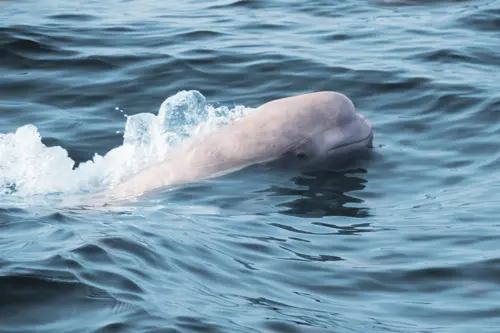
7. The St. Lawrence estuary beluga population is threatened
Did you know that belugas were once the target of an eradication campaign? In the early 20th century, they were considered the number one enemy of local fishermen, who mistakenly believed they were responsible for reducing cod stocks. Fishermen received a $15 bounty from the Government of Quebec for every beluga tail they turned in. The program ended in the 1950s after examinations of carcasses revealed that belugas consumed very little cod.
In response to the alarming decline of the population, the Government of Canada officially banned beluga hunting in 1979. However, concerns remained so significant that protecting the species became one of the driving forces behind the creation of the Saguenay-St. Lawrence Marine Park in 1998.
This protected marine area covers 1,245 km² of the St. Lawrence Estuary and the Saguenay River. Established jointly by the governments of Quebec and Canada, its mission is to preserve these ecosystems for future generations while supporting educational, recreational, and scientific activities through a sustainable-use approach.
Despite numerous conservation measures, the St. Lawrence beluga population was estimated at only about 1,850 individuals in 2023. The species therefore remains threatened, making conservation efforts more important than ever. Committed to preserving this marine mammal, Croisières AML plays an active role in the protection of the beluga and its habitat, notably through its co-founding of the Alliance Éco-Baleine (Eco-Whale Alliance).
Since 2010, the Eco-Whale Alliance has brought together committed partners, including the Group for Research and Education on Marine Mammals (GREMM), Sépaq and Parks Canada, to promote the highest standards in environmentally responsible whale watching tours. Through the use of approximately twenty performance indicators, the Alliance helps reduce the impacts of whale watching activities and supports their sustainable development within the Saguenay-St. Lawrence Marine Park.
8. It is highly social
The beluga is one of the most social cetaceans. It is rarely found alone and most often travels in groups ranging from two to several dozen individuals.
These groups are highly dynamic. Larger gatherings are generally composed of mothers and calves, while males tend to form smaller groups and remain loyal to specific territories.
This flexible social organization encourages cooperation. Belugas often hunt together, coordinating their movements to herd prey or explore feeding grounds. Their sociability is also expressed through a variety of behaviors: they chase one another, play, and engage in tactile interactions that appear to strengthen social bonds.
Researchers have also observed synchronized dives followed by simultaneous surfacing, a behavior that demonstrates their strong cohesion and ability to work together.
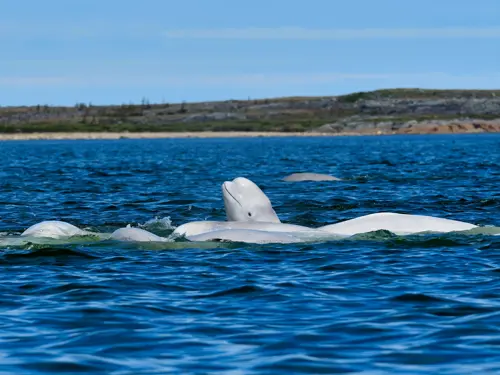
9. The beluga has no dorsal fin
Unlike most whales, the beluga does not have a dorsal fin. This unique anatomical feature is a remarkable adaptation to its northern environment. The absence of a dorsal fin allows belugas to move more easily beneath sea ice without the risk of striking ice sheets or becoming trapped in narrow passages.
Instead, belugas have a ridge or hump, sometimes called a dorsal ridge, which they use in an ingenious way. Combined with the strength of their heads, this rigid structure enables them to break surface ice and create breathing holes. In polar waters, belugas have even been observed breaking through ice layers up to 10 centimeters thick simply by pushing with their heads.
This ability is crucial to their survival. It allows them not only to breathe in confined or changing environments but also to access areas where other cetaceans could not venture.

10. You can adopt a beluga
Did you know it is possible to adopt a St. Lawrence beluga? Offered by the Group for Research and Education on Marine Mammals (GREMM), this initiative pairs an individual or organization with a beluga identified and monitored by researchers through photo-identification. Each beluga has its own story, personality, and life history that you can help support.
Adopting a beluga is much more than a symbolic gesture. It provides tangible support for scientific research, public education, and conservation efforts aimed at protecting this still-threatened population. It is also a meaningful way to demonstrate your commitment to the St. Lawrence and its inhabitants while following your adopted beluga's journey year after year.
How Does the Adoption Program Work?
Choose your beluga from the family album prepared by GREMM. You do not need to worry about housing or feeding your adopted whale. Researchers take care of that in the field!
Give it a name. Your chosen name becomes official and will be used in future scientific communications regarding your beluga.
Make a $5,000 donation, which will support the St. Lawrence Beluga Project, an extensive research and conservation program dedicated to the species.
Receive regular updates about your beluga and the scientific advances made possible through your contribution.
We hope this journey into the fascinating world of the beluga has helped you learn more about this iconic St. Lawrence whale, as mysterious as it is endearing.
Sources:
Fiche espèce béluga - Québec.ca


