
The Magdalen Islands are full of treasures… but you need to know where to look! Fortunately, you’re in the right place. This article will walk you through their rich history, vibrant culture and unmistakable charm. When you finally arrive, you’ll feel as if you already know the Islands, and be eager to explore this slice of Quebec paradise.
Main economic activities
In the Magdalen Islands, people adapt, innovate and, above all… live to the rhythm of the sea. Madelinots have always relied on their unique environment. Descendants of proud Acadian families, they lived for generations from fishing and agriculture, two activities that helped shape the identity of the archipelago.
Even today, the Magdalen Islands’ lobster is known outside Quebec and is still considered one of their standout local specialties.
Over time, some resources such as groundfish have become less abundant, but Madelinots have never lacked ingenuity. New economic activities have emerged to keep the archipelago vibrant.
Tourism now plays a major role and delights visitors and cruise passengers who fall in love with the beaches, red cliffs and warm hospitality of the locals.
Other sectors remain essential, including salt extraction, mining and seal hunting, all deeply rooted in the history and know how of the Islands.
Fishing and mariculture🐟
Once central to daily life in the Islands, groundfish fishing has become much more limited. Many marine species have left the area for various reasons, making catches less abundant than in the past.
That said, lovers of fresh fish will still be pleased to find cod, halibut, mackerel, American plaice, gray sole, redfish, herring and turbot on the menu.
Despite major changes to the marine ecosystem, Madelinot fishers have adapted. The seafood market has grown significantly in recent years, especially thanks to lobster and snow crab, now true local stars.
And that’s not all. Many producers have turned to mariculture, an industry experiencing rapid growth. Local operations make it easy to find mussels, scallops and oysters of exceptional freshness, harvested directly from the surrounding waters.
Local products🍯
In the Magdalen Islands, local terroir is a true source of inspiration. More businesses are emerging based on regional resources, and it’s a pleasure to discover what passionate island artisans can create from their environment.
Seafood is an obvious highlight, but the land has much more to offer. Microbreweries and honey farms are multiplying, supported by the fields and wildflower meadows that brighten the Islands in summer. Some residents raise animals and produce meats and cheeses with a distinct local flavour.
Every shop showcases the archipelago in its own way. The result is a wide array of original, flavourful products deeply tied to their place of origin. During your visit, be sure to step into local boutiques. You’ll be pleasantly surprised by the creativity and dedication of Madelinot artisans… and you’ll likely leave with some delicious finds!
Tourism
In the Magdalen Islands, boredom simply isn’t an option. Whether you love the outdoors, new landscapes, local flavours or discovering unique cultures, the archipelago always has something to offer.
Between hiking trails, lighthouse routes, visits to national reserves, boat excursions, endless beaches perfect for relaxing or taking in the scenery… the hardest part will be deciding what to do first.
And if you need inspiration, the Tourisme Îles de la Madeleine website is full of great ideas for planning an unforgettable getaway.
History
The Magdalen Islands we know today haven’t always looked so peaceful. It all began in 1532, when Jacques Cartier stumbled upon these pieces of land in the middle of the Gulf of St. Lawrence. Captivated by the long beaches, he named them “Les Araynes,” meaning “sand” in Latin. But the name didn’t last long, as explorers enjoyed renaming the Islands as they pleased.
In 1629, Samuel de Champlain suggested “La Magdeleine,” thinking he was referring to Havre Aubert Island. Finally, in 1663, the Islands received their present name when François Honfleur decided to honour his wife, Madeleine Lafleur, by calling them the Îles de la Madeleine.
Battles, Walruses and Territorial Claims
In 1591, French sailors discovered herds of walruses near the Islands and saw an opportunity for a promising trade. They settled there… but the English, eager for this new resource, arrived to seize control. The result: a naval battle!
Fortunately for the French, Indigenous allies came to support them, allowing them to keep the territory. Thanks to the walrus trade, the Islands suddenly became highly sought after and officially appeared on the political map.
A Turbulent Past
For a long time, the Magdalen Islands remained under French control. Several colonization attempts were made with mixed results. The territory mainly served as a guerrilla zone and strategic point due to its resources.
When conflicts erupted in Europe, Acadia was ceded to the British, but the Islands remained French for a while longer. That didn’t stop them from becoming bargaining tools in political negotiations.
The 18th century completely transformed the Islands. This historical turbulence explains much of the cultural richness you find there today. Listen closely as you travel: no two islands share the same accent. And depending on where residents’ ancestors came from during the region’s various upheavals, you may notice traces of their linguistic and cultural heritage. This vibrant mosaic is one of the archipelago’s greatest charms.
🏝️ The Islands
Even though they form a single archipelago, each island has its own character. Local wildlife, cultural influences, landscapes shaped by the wind… each has a unique personality and its own attractions. That’s what makes the archipelago so fascinating. Every crossing feels like stepping into a different world.
Île d’Entrée
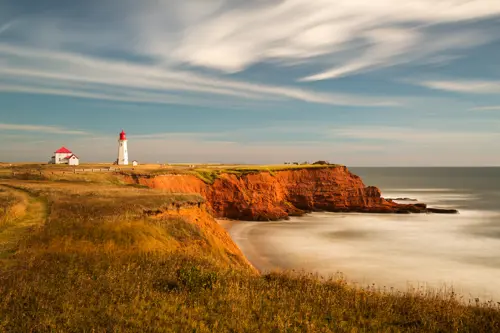
With its rolling green hills and its small number of residents, l’Île d’Entrée almost evokes the Scottish Highlands. A nod to its history, as its inhabitants have preserved their cultural heritage, giving the island a warm and distinctive atmosphere.
It’s also the only inhabited island not connected to the rest of the archipelago by road. This physical separation adds to its charm and gives visitors the sense of entering a calm, isolated and authentic world.
To fully experience this unique atmosphere, let the island’s paths guide you. Hike, explore, take an excursion: everything invites discovery!
Highlights include:
the charming Anglican church
the lighthouse standing watch over the island
the small museum offering insights into local life
If you enjoy hiking, don’t miss Big Hill, the highest point in the archipelago at 174 metres. From the top, the colourful cliffs, rolling meadows and endless sea create a breathtaking panorama.
A weekly ferry connects Entry Island to the port of Cap aux Meules.
Île du Havre Aubert
Birthplace of the first Acadian settlers, l'île du Havre Aubert has preserved architecture and charm that still tell its story. The island is divided into two main sections (Havre Aubert and Bassin), surrounded by a constellation of picturesque villages such as Portage du Cap, La Baie, La Montagne, L’Anse à la Cabane and L’Étang des Caps.
Here, you’ll find postcard worthy landscapes, inviting restaurants, vibrant cultural venues, local boutiques and small cafés perfect for a break.
Havre Aubert is home to the archipelago’s densest forest, a paradise for nature lovers. Whether you head toward the beach or the hills, you’ll find plenty of trails and viewpoints.
Along the scenic route, keep an eye out for:
the solitary Corps Mort rock
the photogenic lighthouse at L’Anse à la Cabane
the lively fishing port
spectacular sunsets
Culturally, Havre Aubert is a must-see. The historic site of La Grave, named after the word “grève,” used to be an important trading area for fishers and merchants. Today, it remains a lively hub of shops, artist studios and cultural events — an area that has kept its soul while reinventing itself.
Île du Cap-aux-Meules
Île du Cap-aux-Meules is the beating heart of the archipelago, offering a mix of urban convenience and rustic charm. It’s the most populated island and home to essential services such as the hospital, high school, cégep, shops and restaurants. If you’re looking for activity and amenities, this is the place.
The island encompases three villages: Fatima, Cap aux Meules and L’Étang du Nord, each with its own personality.
Fatima: A Village with Striking Contrasts
Fatima, the “youngest” village of the archipelago, has plenty to offer. Here you’ll find the beautiful beaches of Dune du Nord and La Belle Anse, where sand and red cliffs create a spectacular backdrop. Perfect for walking, relaxing, taking photos or simply enjoying the waves.
Cap aux Meules: The Main Gateway
Cap aux Meules gets its name from the millstones found in the cliff overlooking the port. As a major harbour village, it’s often the first place visitors see when they arrive. The area is lively with fishing activity, shops and cafés, as well as a seaside trail popular with walkers and cyclists.
This is also where you’ll find the Tourisme Îles de la Madeleine visitor centre, a great stop before exploring further.
L’Étang du Nord: Cliffs and Panoramas
To the west, L’Étang du Nord offers a calmer, more contemplative feel. The Gros Cap scenic road provides stunning views of Plaisance Bay. A little farther, the Gros Cap park features impressive cliffs, sea caves and endless horizons that invite you to pause and take it all in.
Île du Havre aux Maisons
On l’île du Havre aux Maisons, you won’t find forests of trees. Instead, you’ll discover a forest of colourful houses. The traditional Madelinot architecture sets the tone immediately: simple, authentic charm rooted in the island’s history. Locals are particularly proud of their island, often considered the most beautiful of the archipelago.
Its vibrant appearance is also shaped by the southern and northern dunes, where scarlet sand contrasts beautifully with the blue of the Gulf. The Pointe Basse scenic route can be explored on foot, by bike or by car, and its winding roads weaving through hills and pastel coloured houses are irresistible. Photo stops are inevitable.
The Pointe Basse harbour has long been an important site for herring smoking, an activity that played a central economic role. Today, the Fumoir d’Antan keeps this tradition alive and welcomes visitors to discover a unique craft passed down through generations — a true immersion into the maritime heritage of the Islands.
Île de la Pointe-aux-Loups
The smallest inhabited island of the archipelago, île de la Pointe-aux-Loups remains one of its most beautiful. Situated between Fatima and Grosse Île, it offers two long, often quiet beaches perfect for those seeking peace.
Dune du Nord lies to the west, while Pointe aux Loups Beach stretches to the east. Their golden sand, gentle waves and nearly untouched landscape create an atmosphere that encourages slowing down. If serenity is what you’re after, this is the place.
Grosse Île
Deeply shaped by the Scottish roots of its community, Grosse Île has preserved a traditional lifestyle centred around fishing and agriculture. Today, residents primarily rely on fishing and seafood processing plants, but the island is also home to a distinctive salt mine.
To appreciate Grosse Île fully, explore its iconic spots such as Pointe Rockhill, East Cape and Old Harry. Old Harry was once a prime location for walrus hunting, as well as processing and oil extraction. Although walruses have completely disappeared from the archipelago, traces of their presence remain along the rocky haul out areas where they once basked in the sun.
Île de Grande Entrée
If you love seafood, Île de Grande Entrée will feel like heaven. Named the lobster capital in 1994, it is the centre of the archipelago’s lobster fishery. With more than 100 brightly coloured lobster boats, Grande Entrée accounts for over half of the archipelago’s total lobster catch. It’s an incredible sight, especially at sunrise when fishers set out to sea.
The bay also hosts a mussel farming site specializing in blue mussels, another local treasure that highlights the strong bond between the island and the sea.
While you’re there, take the scenic road leading to Boudreau Island. The journey alone offers one of the most stunning panoramas of the entire archipelago.
Île de Brion
Once inhabited, Île de Brion is now completely deserted. Don’t let its limited access deter you. Its near total tranquility has allowed it to develop the most diversified ecosystem in the entire archipelago. Today, Brion is a protected ecological reserve, a natural gem untouched by time.
It is a paradise for birdwatchers, with more than 166 species of birds. The island also hosts hundreds of plant species, including several rare ones, offering a glimpse of pre colonization vegetation.
Although its former Scottish and Acadian residents are long gone, Brion remains steeped in mysterious stories about fishers and lighthouse keepers who once lived there. The lighthouse provides an excellent spot for observing the rich flora and abundant birdlife.
As you can see, the Magdalen Islands form a rich, colourful and truly unique archipelago. Each island reveals its own character, landscapes and stories, making every visit a new discovery.
Feeling inspired to explore the Islands this summer? Take a look at the week‑long travel package offered by our partner Voyages AML.


